Iran Regional FX Hubs: How Herat, Sulaymaniyah, Dubai and Istanbul Move Tehran’s Dollar
How Iran regional FX hubs affect the Tehran dollar: Herat, Sulaymaniyah, Dubai and Istanbul, trading hours, arbitrage, lead and lag, and API comparison.

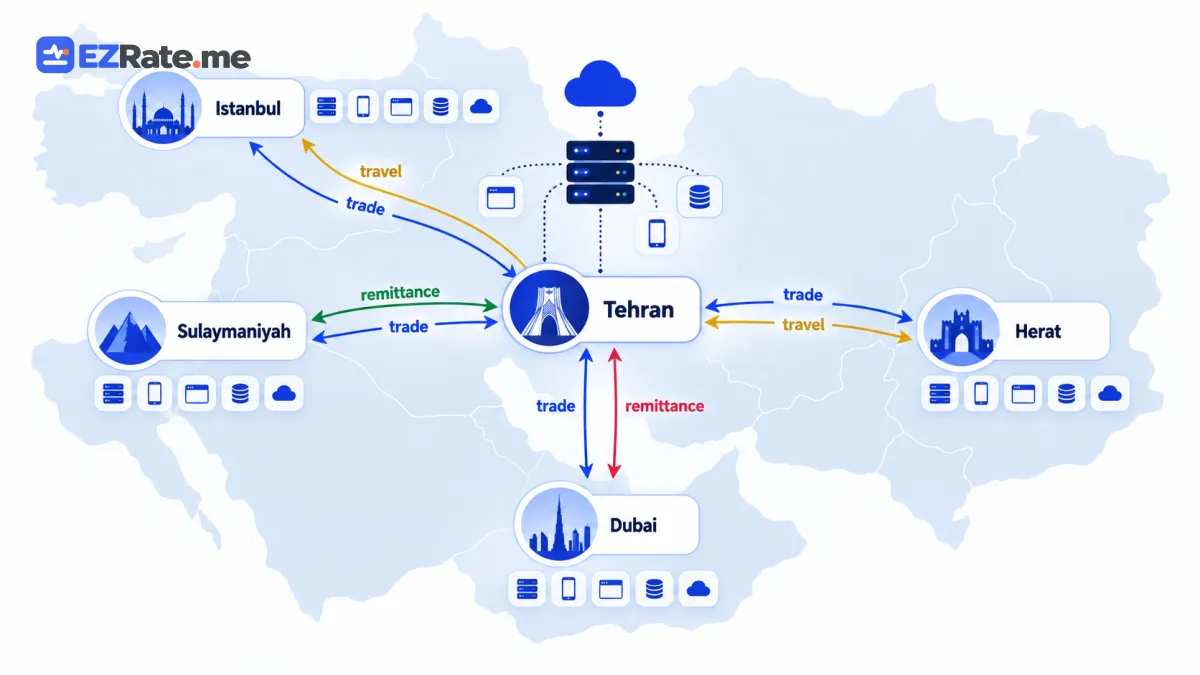
- Four cities trade the dollar against the Toman alongside Tehran: Herat, Sulaymaniyah, Dubai and Istanbul.
- Border hubs often move first on holidays and during sudden news; on normal business days Tehran usually leads.
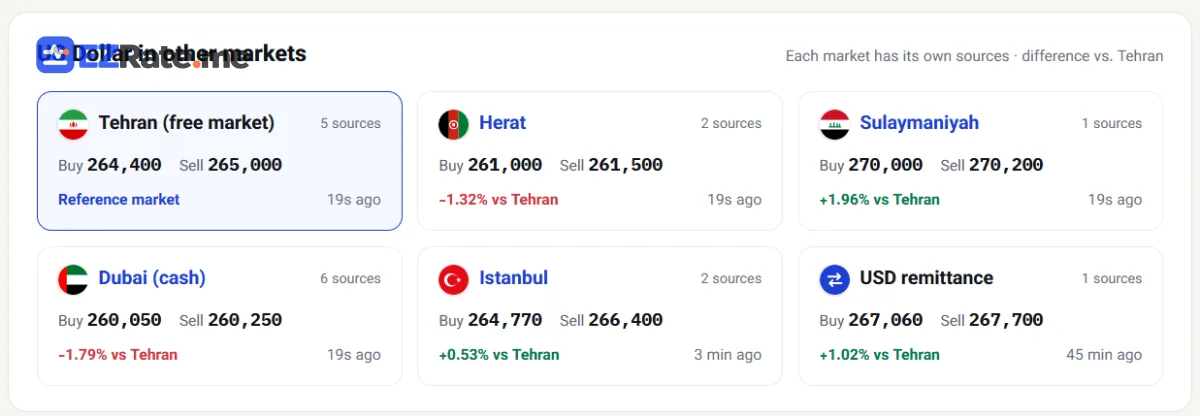
- `/v1/markets/usd` returns each hub’s rate and its percentage gap to Tehran in one call.
The Tehran dollar does not trade in isolation. Cross-border trade, remittances and the Iranian diaspora have created active Toman markets in neighbouring cities. Understanding these Iran regional FX hubs helps traders read the market on holidays and helps analysts explain gaps between sources.
/v1/markets/usd, and treat thin, low-source quotes with caution.Part of the Iranian Rial exchange rate API guide.
The four hubs
| Hub | Why it trades Toman | Typical role |
|---|---|---|
| Herat | Border trade between western Afghanistan and Iran | Early signal, especially on Iranian holidays |
| Sulaymaniyah | Active currency market in Iraqi Kurdistan; trade with western Iran | Early signal; sensitive to regional news |
| Dubai | Main hub for Iranian trade settlement and remittances | Sets the remittance (havale) premium |
| Istanbul | Travel, students, property and trade with Turkey | Cost of converting for Iranians in Turkey |
How the hubs stay in line
- Arbitrage: when a gap exceeds transport and transfer costs, traders move money and close it.
- Different hours: hubs follow their local calendars, so they can trade when Tehran is closed.
- Expectations: traders in Tehran watch the hubs; a move abroad changes the opening price at home.
Lead or lag?
| Situation | Typical behaviour of border hubs |
|---|---|
| Normal business day in Tehran | Follow Tehran with a small gap |
| Iranian public holiday | Can be more active and lead |
| Sudden political or economic news | Fast, sometimes exaggerated reaction |
| Very thin trading | Scattered quotes; more manipulation risk |
USDT is the other 24/7 signal: see USDT to IRT API and USDT premium.
Comparing hubs with the API
curl -s -H "X-API-Key: $EZRATE_KEY" "https://api.ezrate.me/v1/markets/usd?lang=en" | jq '.data[] | {market, sell, diff_pct_vs_reference, updated_at}'[
{ "market": "tehran", "sell": 0, "diff_pct_vs_reference": 0.0, "updated_at": "…" },
{ "market": "herat", "sell": 0, "diff_pct_vs_reference": 0.4, "updated_at": "…" },
{ "market": "sulaymaniyah", "sell": 0, "diff_pct_vs_reference": -0.2, "updated_at": "…" },
{ "market": "dubai", "sell": 0, "diff_pct_vs_reference": 1.1, "updated_at": "…" }
]Always check updated_at: a hub that has not updated for hours is not a signal. Historical series per market are available with /history/usd?market=herat, which is useful for lead-lag studies (see historical USD/IRR data).
Pitfalls
- Unit confusion: quotes in Herat may be in afghani and in Sulaymaniyah in dinar; compare only Toman prices.
- Side confusion: compare sell with sell.
- Stale reposts: an old quote forwarded again looks like a new signal.
- Thin data: fewer sources mean more noise; EZRate flags this with
low_sources.
The Dubai premium deserves its own article: AED hawala rate. Persian readers can find a deeper market analysis in Herat and Sulaymaniyah dollar effect.
Why traders watch the hubs
For traders in Tehran, the regional hubs are a window into the market when the local market is quiet. On a Friday or a long holiday, a steady rise in Herat or Sulaymaniyah alongside a rising USDT price often foreshadows a higher opening in Tehran. For businesses, the hubs matter for a different reason: the Dubai and Istanbul rates are what remittances and foreign purchases actually cost. Watching both gives a more complete view than any single number.
Keep in mind that hub prices are reported by fewer sources than Tehran. Before acting on a move in one hub, check whether others and USDT confirm it, and look at the timestamps.
Related live rates: dollar in Herat, US dollar rate, dollar in Dubai.

Comments (0)
Comments are shown after review. Sign-in is needed to send.