USDT Premium in Emerging Markets: Why Tether Trades Above or Below the Dollar
Why there is a USDT premium in emerging markets like Iran: capital controls, 24/7 liquidity, conversion costs, venue risk and what the gap signals.

- In markets with capital controls, USDT is a gateway to dollar value and international transfers, so it often trades above the local cash dollar.
- Conversion costs, venue risk and different trading hours keep the gap from closing fully.
- The premium is a useful sentiment indicator, especially when the cash market is closed.
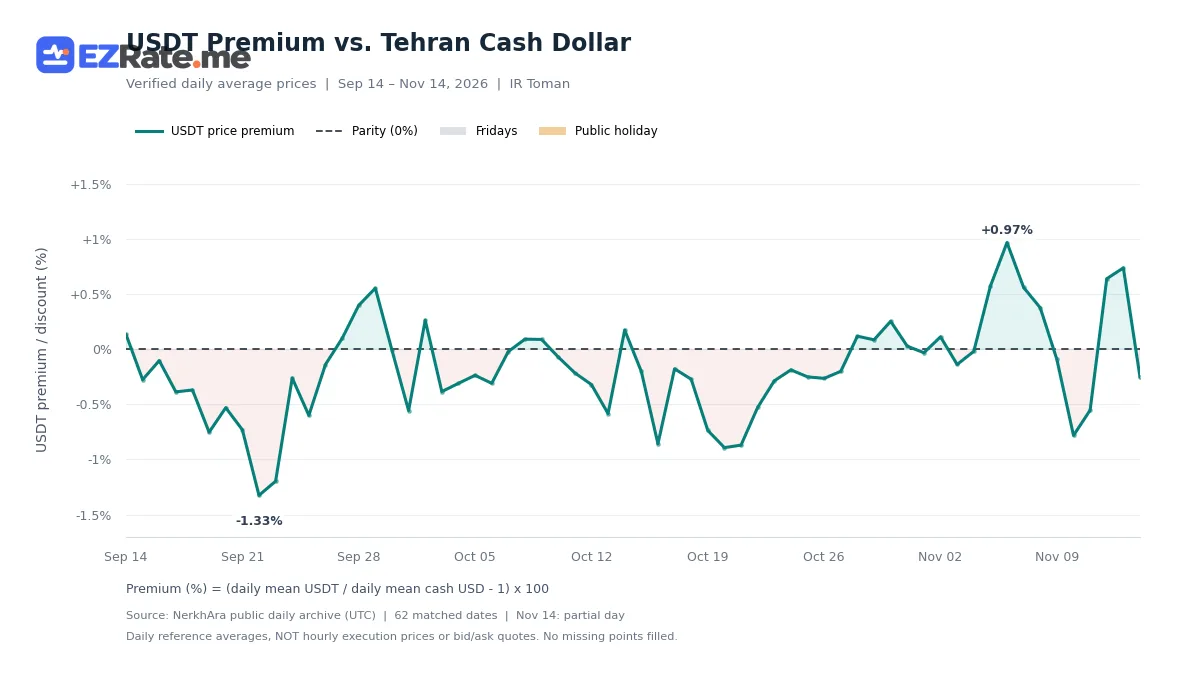
In theory one Tether equals one dollar. In Tehran, Lagos or Buenos Aires the local price of USDT and the local price of a cash dollar can differ by a few percent — sometimes more. This USDT premium in emerging markets is not a mistake; it is the price of a different kind of access. Here is why it exists and how to read it.
Defining the premium
premium = usdt_local / usd_cash_local - 1 # +0.02 means USDT is 2% above the cash dollarUse the same side (sell vs sell) and the same moment for both prices. In Iran: usdt and usd from the EZRate API, both in Toman.
Why a premium appears
- Capital controls: USDT can move value abroad faster than banks or cash.
- Always open: when exchange offices are closed, USDT is the only liquid dollar proxy; overnight demand shows up in its price.
- Crypto on-ramp: traders need USDT to access global markets.
- Expectation leadership: USDT reacts first to news, so its premium widens when people expect the cash dollar to rise.
Why a discount appears
- Venue risk: withdrawal limits, regulatory pressure or a hack at local exchanges make holders sell.
- Issuer concerns: doubts about reserves lower demand.
- Cash scarcity: when physical dollars are scarce, cash can trade above USDT.
- Heavy local selling: e.g. miners or exporters converting proceeds.
Why arbitrage does not close it
| Friction | Effect |
|---|---|
| Exchange and network fees | Several tenths of a percent per leg |
| Spreads | Paid on both legs |
| Settlement time | Price risk while waiting for transfers |
| Withdrawal limits and KYC | Cap the size of trades |
| Counterparty risk | P2P or intermediaries may fail to deliver |
| Legal uncertainty | Rules on crypto and FX can change |
Persian readers will find a deeper look at the costs in USDT–dollar arbitrage.
Reading the signal
| Premium | Common interpretation |
|---|---|
| Rising on a weekend | Expectation of a higher cash dollar at the next open |
| Spiking suddenly | Venue-specific event or panic buying; check source counts |
| Persistent discount | Venue stress or abundant USDT supply |
| Near zero | Balanced, well-arbitraged market |
Beyond Iran
The same pattern appears wherever access to dollars is restricted or slow: stablecoins become a parallel dollar market with its own price. The size of the premium tends to track the strength of capital controls and the cost of the official alternatives. What makes Iran distinctive is the depth of its cash free market, which gives a clear benchmark to measure the premium against.
Tracking the premium over time, rather than reacting to single readings, gives the most reliable signal.
Related live rates: USDT price, US dollar rate.
Comments (0)
Comments are shown after review. Sign-in is needed to send.