AED Hawala Rate: The Dubai Dirham and Its Impact on USD/IRR
How the AED hawala rate works in Iran: the 3.6725 dirham peg, Dubai remittance pricing, why AED/IRR drifts from the implied rate and what the gap signals.


- The UAE dirham is pegged at 3.6725 per US dollar, so the Toman price of AED closely tracks the dollar.
- A large share of Iran’s trade settles through Dubai; remittance (havale) demand can push AED and the Dubai dollar above the implied rate.
- The gap between the AED rate and USD ÷ 3.6725 is a useful signal of remittance demand.
Ask an Iranian importer which exchange rate matters most and the answer is often not the cash dollar but the Dubai rate. The UAE is a major hub for Iranian trade settlement, and the price of moving money there — the hawala or “havale” rate — shapes what businesses pay. This article explains the AED hawala rate in Iran and how it relates to USD/IRR.
Part of the Iranian Rial exchange rate API guide.
The peg
The Central Bank of the UAE has held the dirham at 3.6725 per dollar since the late 1990s. Internationally, one dollar is effectively always 3.67 dirhams. For Iran’s market this means AED and USD move together in Toman terms, and any persistent difference has a local cause.
| Hypothetical USD (Toman) | Implied AED (Toman) |
|---|---|
| 90,000 | ≈ 24,506 |
| 100,000 | ≈ 27,229 |
| 110,000 | ≈ 29,952 |
What “hawala” means here
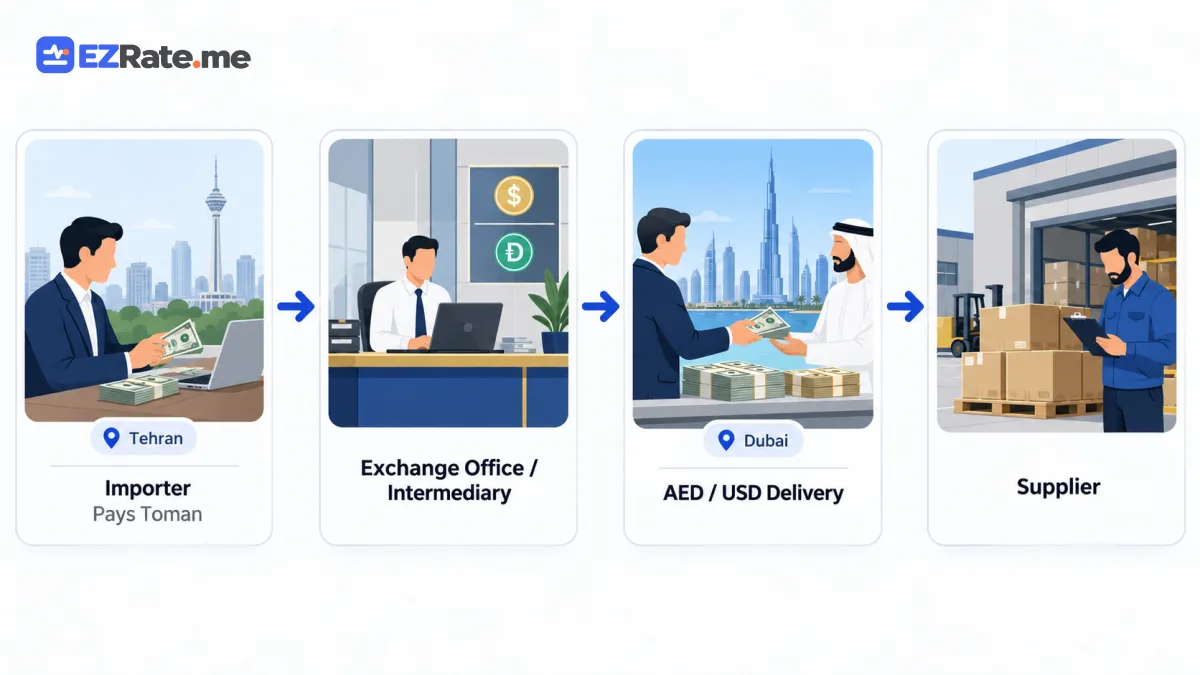
Hawala is an informal value-transfer system: you pay Toman in Tehran and a counterpart delivers dollars or dirhams to an account or person in Dubai. In Iran’s market this is usually called “havale” (remittance). It is priced separately from cash because it solves a different problem — paying a supplier abroad — and carries different costs and risks. Our guide free-market dollar vs havale covers this in depth.
Why AED drifts from the implied rate
- Remittance demand: when importers rush to pay suppliers, AED and the Dubai dollar rise above the implied level.
- Cash vs transfer: banknotes carry transport, insurance and storage costs.
- Liquidity: the AED market in Tehran is thinner than USD; large trades move it more.
- Timing: the dollar often moves first; AED catches up minutes or hours later.
Measuring the gap with the API
import os, requests

H = {"X-API-Key": os.environ["EZRATE_KEY"]}
rates = {x["symbol"]: x for x in requests.get(
    "https://api.ezrate.me/v1/rates", headers=H, params={"symbols": "usd,aed"}, timeout=10
).json()["data"]}

implied = rates["usd"]["sell"] / 3.6725
gap = rates["aed"]["sell"] / implied - 1
print(f"AED vs implied: {gap:+.2%}")

dubai = requests.get("https://api.ezrate.me/v1/markets/usd", headers=H, timeout=10).json()["data"]
print({m["market"]: m["diff_pct_vs_reference"] for m in dubai})   # dollar in Dubai vs Tehran
/markets/usd returns the dollar in each market with its percentage difference from Tehran — the Dubai row is the remittance premium in practice.
Reading the signal
| Observation | Common interpretation |
|---|---|
| AED and Dubai dollar above implied | Strong demand for transfers abroad; often pressure on USD |
| AED below implied | Ample dirham supply (exports, repatriation) or USD jumped first |
| Gap near zero | Balanced market, active arbitrage |
These are tendencies, not rules. Combine them with USDT and the border markets: Iran’s regional FX hubs.
Using the AED rate in a business
For an importer paying a supplier in Dubai, the relevant cost is not the cash dollar in Tehran but what it costs to deliver dirhams or dollars to the supplier’s account. Price your goods from the AED rate (or the Dubai dollar) and keep the implied-rate gap as a monitoring metric. When the gap widens, remittance is getting more expensive and your landed cost is rising even if the Tehran dollar is flat. Persian readers can find a full explanation in dirham and dollar relationship.
Related live rates: UAE dirham rate, dollar in Dubai, US dollar rate.
Comments (0)
Comments are shown after review. Sign-in is needed to send.